
Let AI propose the queue. Let support own the decision.
A ticket classifier can suggest where a request belongs. This worked example shows how to evaluate that suggestion, handle ambiguity and prevent customer text from becoming an instruction to the system.
Worked example. This is a proposed solution for a fictional operating scenario, not a client engagement. No measured results are claimed.

- The problem
- Support staff repeatedly classify incoming tickets, while incorrect routing adds another handoff.
- The approach
- Use a bounded classification proposal with validation, human review and a labeled evaluation set.
- Intended outcome
- The intended benefit is reduced classification effort where evaluation supports it. No accuracy, staffing or resolution result has been measured.
Example system roles Help desk · approved model endpoint · evaluation set · reviewer queue
Choose a task small enough to judge
Assume a software support team has defined queues for billing questions, technical faults and account-access requests. Agents currently read each ticket and select a queue. The proposal automates only that classification suggestion.
It doesn't send replies, issue refunds, reset credentials or decide whether an incident is resolved. Access and security-sensitive requests use the team's existing escalation policy. The workflow should make that boundary visible in its output and permissions.
The category list is part of the contract
Give each allowed category a definition, examples and an owner. Require the model to return a category, a brief reason grounded in the ticket and references to the relevant text. Reject outputs outside the allowed schema.
An unknown category, contradictory content or missing context goes to review. A model's self-reported confidence is not a calibrated probability. Use observed performance by category to choose where suggestions can be applied.
Customer text is untrusted input. A ticket that says ignore your instructions or asks the model to change an account must remain ticket content. The classification component should have no tools or credentials capable of carrying out those actions.
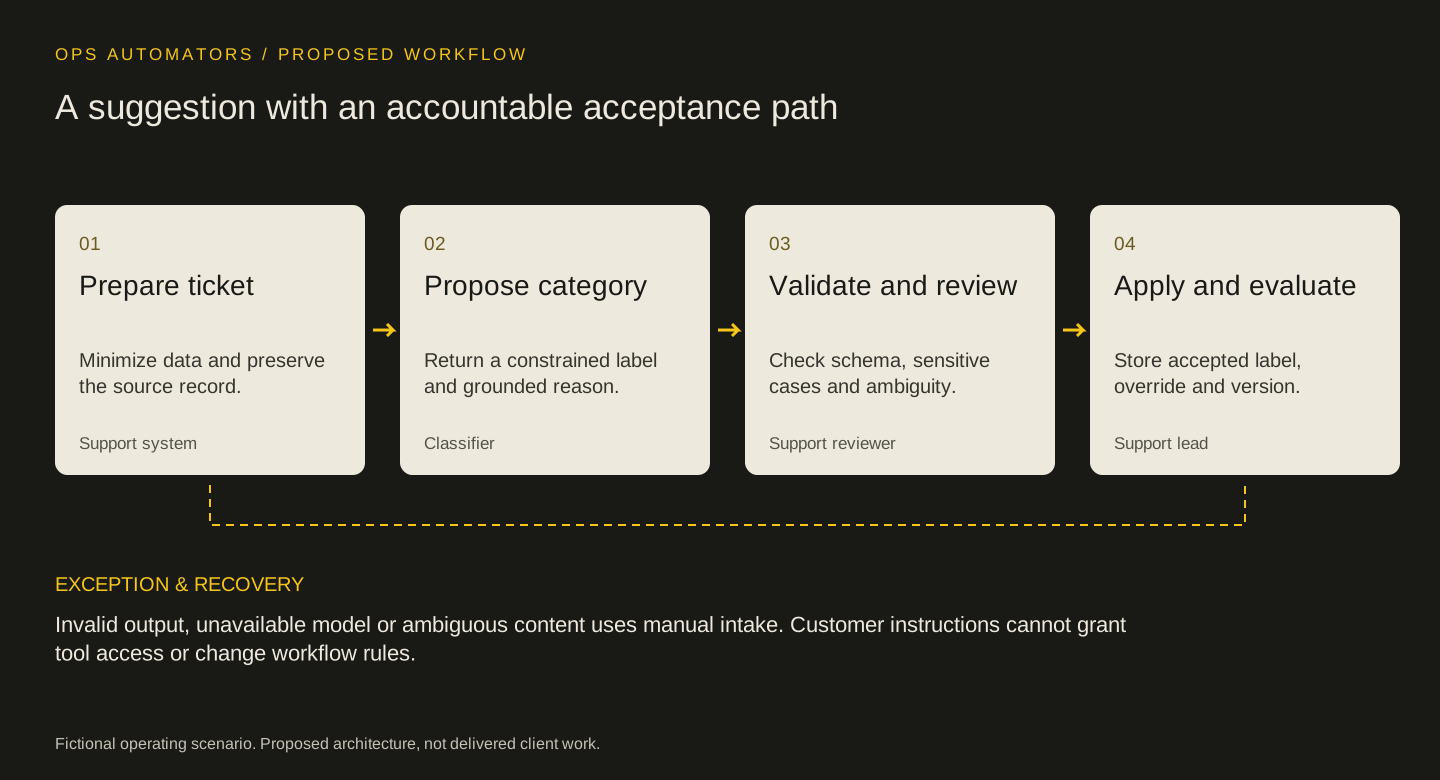
Proposed workflow
A suggestion with an accountable acceptance path
Prepare ticket
Minimize data and preserve the source record.
Support systemPropose category
Return a constrained label and grounded reason.
ClassifierValidate and review
Check schema, sensitive cases and ambiguity.
Support reviewerApply and evaluate
Store accepted label, override and version.
Support lead
Invalid output, unavailable model or ambiguous content uses manual intake. Customer instructions cannot grant tool access or change workflow rules.
A reviewer needs evidence and an override
Show the proposed queue beside the ticket, with the relevant excerpt and failed validation if any. The reviewer accepts or changes it and records a correction reason. Preserve the original model output separately from the accepted label.
Keep the human correction from immediately becoming an unquestioned training label. Ambiguous cases need a shared labeling rule, and disagreements between experienced agents may reveal that the category definitions are weak.
If the model endpoint is unavailable, route tickets through the existing manual intake. Do not leave the support queue waiting for a retry to finish.
Evaluate the errors that create extra work
Build a permissioned evaluation set from representative requests, with sensitive data minimized. Include short messages, several issues in one ticket, unusual wording, malicious instructions and tickets whose category can't be inferred from the text.
Count reroutes as work
Have support label the intended routing decision. Keep evaluation cases separate from prompt-tuning examples. Report a confusion matrix by category and the proportion requiring review; one overall accuracy figure can conceal a weak account-access class.
Measure total handling effort, including corrections and reroutes. Saving the first classification click is not useful if the receiving team has to undo the decision.
Release one category at a time
Start in suggestion mode. If reviewed evaluation and a limited pilot support it, apply a narrow category automatically while retaining an override and sampling its output. Record model, prompt and category-definition versions.
When the product, ticket mix or model changes, reevaluate the affected cases. The support lead owns category meaning and routing policy; the integration owner monitors availability and schema failures. A native help-desk rule may be sufficient for deterministic categories such as a dedicated billing intake address.
Keep this part
Support triage evaluation matrix
If support can't agree on the right queue, the model doesn't have a stable answer to learn.
| Case family | Expected treatment | What to inspect |
|---|---|---|
| Clear billing question | Propose billing queue | Correct category and grounded reason |
| Several unrelated issues | Review or approved multi-issue policy | No invented single answer |
| Account-access request | Use defined sensitive-case review | No credential or account action |
| Prompt-injection attempt | Treat instructions as ticket text | No policy or tool change |
| Insufficient context | Request reviewer decision | No confident invented facts |
| Model unavailable | Continue manual intake | Ticket remains owned |
Use the example to agree the rules, then fill in the blank sheet with your own records and owners. Downloads are free; no email required.
Evidence & limits
How to evaluate the proposal
Report labeled sample size, category mix, per-category errors, review rate and end-to-end handling time. Keep model and prompt versions fixed during comparisons. Synthetic examples here are test ideas, not an accuracy benchmark.
- No model has been evaluated on the user's support data in this worked example.
- Automatic application requires evidence by category and a maintained manual fallback.
- The classifier is an optional aid. Support remains responsible for coverage and can keep the process manual if evaluation does not justify the change.
The design decisions and worksheets are original worked-example material. Vendor documentation supports specific platform behavior, not a claim that this implementation has been delivered.
How this page was prepared
AI assisted the research, drafting and conceptual artwork, helping compare source material and turn the workflow into a reusable worksheet. The scenario is fictional and the design is a proposal. The stated sources and limitations define the evidence available. No independent expert review or client result is implied.
About the team commissioning this collectionContinue with the useful detail
Where this connects.


Your next step
Which support category can your team label consistently?
Start with the category definitions and a small redacted sample. We can design an evaluation and review path before automating assignment.